
Beyond Active learning
How not to be a passive instructor in an active classroom.

Active learning is typically defined as a learning experience in which students are actively engaged in their own learning. This can take many forms, from group work and field trips to projects and inquiry-based learning. In recent years, active learning has gained significant traction, especially at the college level. More classrooms now encourage students to participate actively in their learning by interacting, exploring, creating, and collaborating. However, even in an active classroom, instructors may still risk facilitating active learning in a passive way. Active learning does not necessarily mean active teaching.
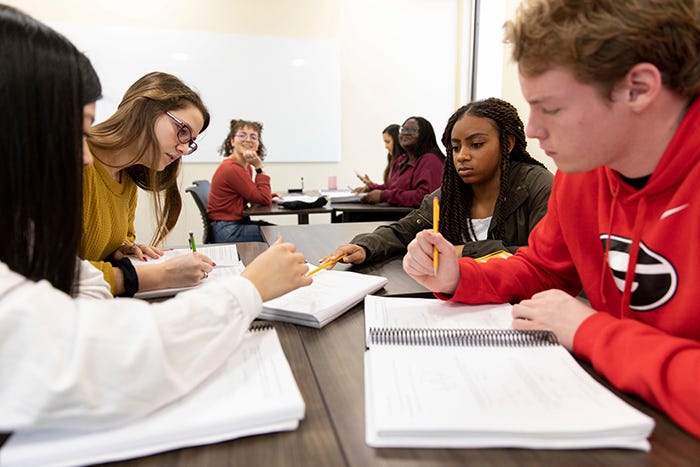
An active learning classroom often has students seated at tables facing each other, rather than looking at a teacher positioned at the front. A popular phrase that captures the spirit of this approach is “be the guide on the side, not the sage on the stage.” The primary goal is to put students at their learning at the center of the learning experience. At first, this approach can feel daunting, as it requires instructors to relinquish some control over classroom dynamics. However, numerous studies support active learning as a highly effective way for students to learn, especially in mathematics. Paul Halmos famously said, “The only way to learn mathematics is to do mathematics.”
Active learning can take many forms, but all require students to actively participate rather than passively absorb content. Typically, this involves structured activities such as group work, guided worksheets, think-pair-share, gallery walks, and jigsaw activities. In planning a lesson, instructors often allocate specific time blocks for each activity, allowing students to work through tasks before moving on. Yet, even with active learning activities, instructors can sometimes adopt a passive role, simply moving from one activity to the next without responding to the dynamics in the room.
The natural complement to active learning—engaging students in their own learning—is active teaching, which requires instructors to be responsive to students’ learning as it unfolds. Active teaching involves observing and responding to what’s happening in the classroom and, when necessary, adjusting the original lesson plan.
One simple way to practice active teaching is by being flexible with the time allocated for each planned activity. Students may need more time to complete certain tasks, and adapting to this need is crucial for maintaining a productive learning environment. This flexibility may mean not completing all planned activities, but it ensures that students have adequate time to engage with key concepts. Planning for this flexibility might then require being intentional about meeting the learning objetives in potentially different ways.
Recently, I applied this philosophy in one of my calculus courses, even outside regular class time. I noticed that students could improve on a particular topic after seeing their exam performance. While their grades were fair, I could see room for growth in a key learning goal essential for calculus. To address this, I offered students the opportunity to explain the solution to a problem during office hours for extra credit. This allowed me to respond to their learning needs based on exam results and encourage them to engage more deeply by explaining mathematical concepts to someone else.
Just as active learning can take many forms, active teaching also has diverse applications. Examples include:
Being receptive to questions and adjusting information or presentation based on students’ responses.
Monitoring classroom activities and modifying time allocations based on student feedback.
Having a range of activities prepared and selecting the most relevant ones based on the current classroom environment or student interests.
Following a Socratic approach, using student input to guide discussions and deepen understanding.
Active teaching complements Active learning, both during class and beyond. The main goal is for students and instructors alike to be engaged participants in the learning process, adapting to the needs and dynamics of each class.